

Too Many Devices, Too Little Rest
We have quietly turned our most sacred spaces — the bedroom and the living room — into electronic substations. The average modern bedroom contains a smartphone charging on the nightstand, a Wi-Fi router humming down the hall, a television on the wall, a laptop on the bed, and perhaps a smart speaker, a gaming console, and several LED bulbs overhead. We sleep surrounded by this infrastructure every night and spend our evenings bathed in its output, rarely stopping to ask what all of it is actually doing to us.
The answer, increasingly supported by research, is quite a lot — and very little of it is good.
Electromagnetic Fields: The Invisible Fog
Every device that draws power or transmits a signal generates an electromagnetic field. Your phone emits radiofrequency radiation constantly as it pings cell towers and Wi-Fi networks, even when you are not actively using it. Your router broadcasts microwave-frequency signals in all directions, 24 hours a day. Your television, laptop, and smart devices add their own layers to this invisible fog that fills the room.
Prolonged EMF exposure has been linked in multiple studies to disrupted sleep architecture — specifically a reduction in melatonin production, the hormone that regulates your sleep-wake cycle. The pineal gland, which secretes melatonin in darkness, appears to be sensitive to electromagnetic interference. People who sleep in high-EMF environments consistently report taking longer to fall asleep, waking more frequently through the night, and feeling less restored in the morning regardless of how many hours they spent in bed.
Beyond sleep, chronic low-level EMF exposure has been associated with headaches, cognitive fatigue, difficulty concentrating, and in longer-term studies, elevated markers of oxidative stress in cells.
Positive Ions: The Air You Cannot Feel
Electronic devices are relentless generators of positive ions — electrically charged particles that accumulate in enclosed spaces filled with running technology. Air conditioning and heating systems, which recirculate the same indoor air repeatedly, amplify the effect further. The result is an atmosphere that is electrically saturated in precisely the wrong direction.
High concentrations of positive ions in the air have measurable physiological effects. They reduce the production of serotonin, increase cortisol, promote a state of low-grade physiological stress, and have been shown to worsen respiratory function. People in positively ionized environments report elevated irritability, fatigue, difficulty breathing, and a persistent sense of unease that they often cannot attribute to any obvious cause — because the cause is invisible.
This is why stepping outside after hours indoors often produces an immediate and disproportionate sense of relief. Nature — particularly near water, trees, and open air — is densely negative-ion rich. Your device-filled bedroom is the opposite.
Flickering LEDs: The Light Your Eyes Cannot Ignore
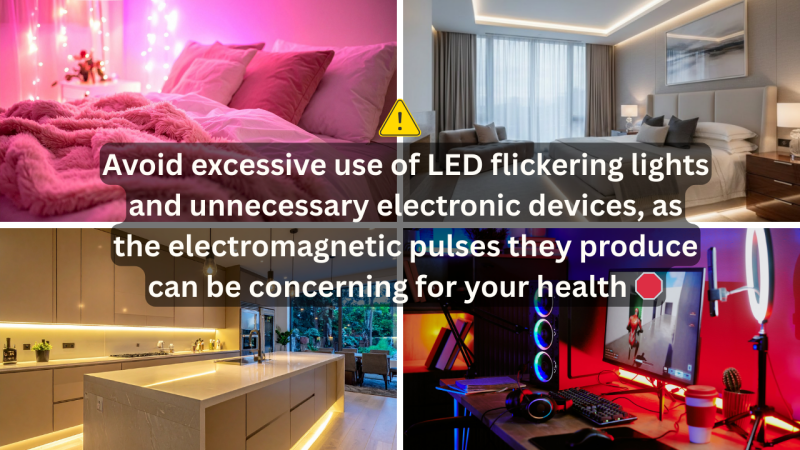
Modern LED bulbs and screens flicker. Most people believe they are looking at a steady light source, but LEDs operate by switching on and off at high frequencies — often between 50 and 400 times per second. While this is too fast for conscious perception, it is not too fast for the nervous system.
The visual cortex and the brain's stress response systems detect this flicker subconsciously. Studies have linked exposure to flickering artificial light with increased eye strain, tension headaches, elevated cortisol, impaired visual processing, and in sensitive individuals, migraine triggering. In the evening, when the brain is attempting to downregulate for sleep, the flickering blue-heavy light from screens and LED fixtures actively suppresses melatonin and keeps the nervous system in a state of alert wakefulness long past the point when it should be winding down.
The cumulative effect of spending several evening hours in a room lit by flickering LEDs while staring at a flickering screen is a nervous system that arrives at bedtime in a state of covert overstimulation — tired but wired, unable to cross into deep, restorative sleep.
What You Can Do
The solution is not to abandon technology entirely but to be deliberate about when, where, and how it surrounds you. Removing devices from the bedroom — or at minimum switching them to airplane mode at night — reduces your EMF exposure during the eight hours when your body is most vulnerable. Adding plants, particularly high-transpiration species like the areca palm or Boston fern, actively restores negative ions to the air. Switching to high-quality LED bulbs with a high CRI rating and low flicker index, and using warm-toned lighting in the evening, dramatically reduces the neurological cost of artificial light. And simply spending time outdoors each day gives your nervous system the natural negative-ion bath it was designed to receive.
Your bedroom should be the most biologically supportive room in your home. Right now, for most people, it is one of the most electrically hostile.