

🌿 The Living Air: How Indoor Plants Transform Your Health at Work and at Home
Introduction
We spend the vast majority of our lives indoors — at desks surrounded by screens, routers, printers, and air conditioning systems. What most people don't realize is that these environments are quietly working against us: filling the air with invisible toxins, bombarding us with electromagnetic fields, and saturating our surroundings with positive ions that disrupt our body's natural balance. The humble houseplant, sitting quietly in its pot, is one of the most powerful and underrated tools we have to fight back.
The Invisible Threat: Electromagnetic Fields and Positive Ions
Every electrical device you own — your laptop, phone, Wi-Fi router, television, microwave — emits electromagnetic fields (EMF). Prolonged exposure to EMF has been linked in various studies to fatigue, headaches, sleep disruption, and difficulty concentrating. While the science is still evolving, many health professionals recommend minimizing unnecessary exposure wherever possible.
Closely related to this is the issue of positive ions. Electrical devices are major generators of positive ions — tiny charged particles that accumulate in closed indoor spaces. Air conditioning and heating systems amplify this effect. High concentrations of positive ions in the air have been associated with irritability, anxiety, fatigue, difficulty breathing, and impaired immune response. Think of the heavy, stagnant feeling in a room full of running computers — that's positive ion saturation at work.
Nature's Answer: Negative Ions and How Plants Generate Them
Negative ions are the antidote. They are abundantly found in nature — near waterfalls, forests, the ocean, and after a rainstorm — and they are precisely what makes outdoor air feel so refreshing and energizing.
Plants release negative ions through a process tied to photosynthesis and transpiration. As water molecules evaporate from the surfaces of leaves, they break apart and release electrons that attach to surrounding air molecules, forming negative ions. Certain plants — particularly those with large, waxy, or dense leaf surfaces — are especially effective at this.
The health benefits of negative ions are well documented. They help neutralize positive ions and airborne pollutants by causing particles to clump together and fall out of the air. They have been shown to improve mood, reduce stress hormones like cortisol, enhance alertness, improve sleep quality, and even support respiratory health by clearing the airways of allergens and dust.
In short, a room with several well-chosen plants begins to mimic the air quality of a forest clearing.
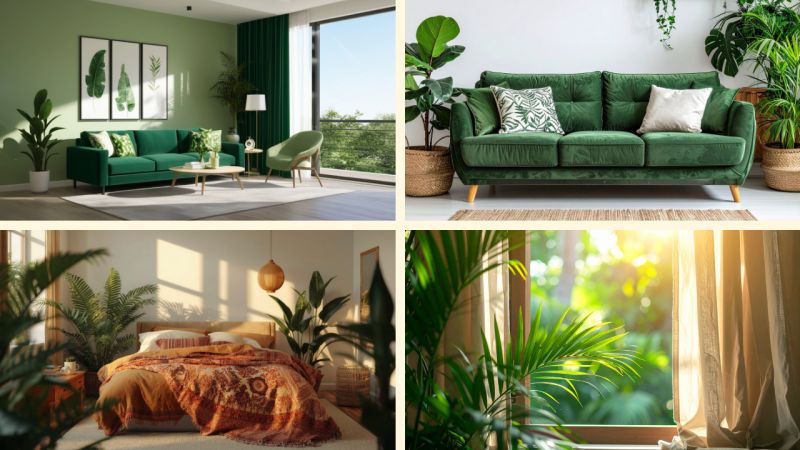
Air Filtration: Plants as Living Purifiers
Beyond ions, plants are remarkably effective at removing chemical pollutants from indoor air. The pioneering NASA Clean Air Study identified numerous common houseplants capable of absorbing and neutralizing volatile organic compounds (VOCs) — toxic gases released by furniture, carpets, paint, cleaning products, and electronics.
The most common indoor toxins include:
- Formaldehyde — released by pressed wood furniture, adhesives, and some fabrics
- Benzene — emitted by plastics, rubber, and synthetic fibers
- Trichloroethylene — found in paints, varnishes, and adhesives
- Xylene and toluene — off-gassed by printers, copiers, and computer screens
- Ammonia — common in cleaning products and some building materials
Plants absorb these compounds through tiny pores in their leaves called stomata, and the microorganisms living in their root systems break them down into harmless byproducts. The result is measurably cleaner, fresher air — and a noticeable difference in how alert and comfortable you feel throughout the day.
The Bedroom Dimension: Sleep, Recovery, and Nighttime Air
The bedroom is where your body repairs itself. Air quality during sleep has a direct impact on how deeply you rest and how well you recover. Most plants absorb CO₂ and release oxygen during the day through photosynthesis. A select few — including succulents, orchids, snake plants, and aloe vera — use a special process called CAM (Crassulacean Acid Metabolism) that allows them to continue releasing oxygen at night, making them ideal bedroom companions.
Improved oxygen levels during sleep translate to better cellular repair, more restful rest, reduced snoring, and a more refreshed feeling upon waking. Combined with their negative ion output, bedroom plants create a micro-environment that is measurably more restorative than a bare room.
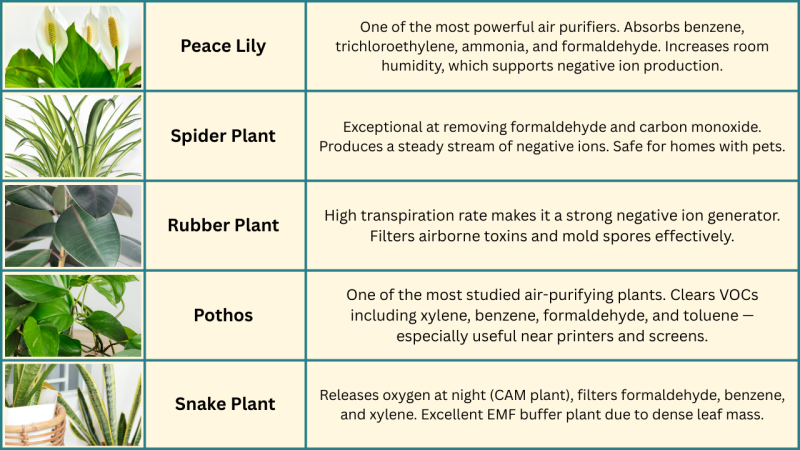
A Guide to the Best Indoor Plants
Below is a curated list of indoor plants, what they look like, and what they specifically do for your health and environment.
Practical Tips for Maximum Benefit
To genuinely feel the difference plants make, placement and quantity matter. Aim for at least one medium-to-large plant per 10 square meters of indoor space. In a workspace, clustering two or three plants near your desk — particularly between you and your router or monitor — creates a measurable buffer zone of cleaner, ion-balanced air. In the bedroom, a snake plant or aloe on the nightstand, with a Boston fern or areca palm in the corner, can noticeably improve the quality of your sleep over just a few weeks.
Water your plants consistently, as a well-hydrated plant transpires more, generating more negative ions and better humidity. Keep leaves clean and dust-free — clogged stomata reduce air filtration efficiency significantly.
Conclusion
Plants are not decoration. They are biological systems that actively clean, charge, and refresh the air around them. In a world where most of us live and work in sealed, electrically saturated environments, placing living plants in our spaces is one of the simplest, most beautiful, and most evidence-supported things we can do for our health. The air you breathe shapes your mood, your focus, your sleep, and your resilience. Let it be green.
Diving Deeper into Paludariums
In previous discussions, we've explored the myriad benefits of indoor plants. Now, if you're interested in going further into the fascinating world of paludariums, you're in the right place. Paludariums combine the elements of an aquarium and a terrarium, creating a lush, self-sustaining ecosystem that can bring a unique aesthetic to your indoor space.